Research
Summary
Since the late 19th century scientists have tried to understand human movement in crowds. Although research has demystified crowds (they are neither swarms, homogeneous, nor irrational), coordinated movement in crowds remains a scientific puzzle. We know crowds have different repertoires (walking, forming lanes, queuing) and can rapidly transition between them. This behaviour is important for practical safety reasons and for fundamental understanding of mass behaviour. But current models do not describe rapid transitions well. This is because crowd behaviour is the result of an interplay between physical and socio-psychological factors. While the human body integrates the two effortlessly, science has yet to succeed.
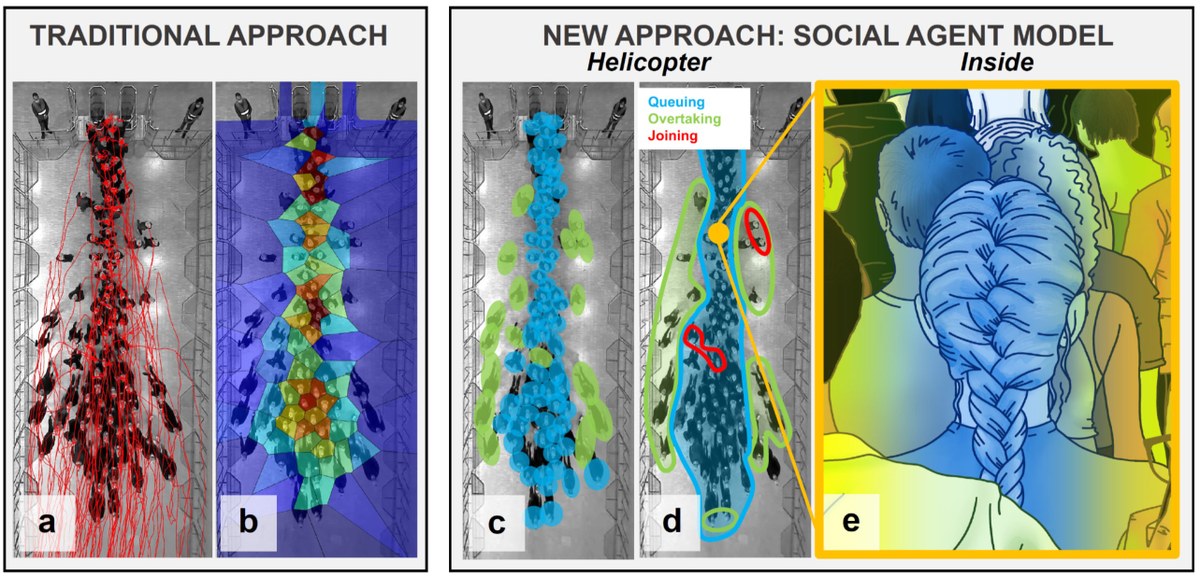
Our breakthrough is to integrate the physics and social psychology of crowds in one model. Conceptually, our groundbreaking innovation is to integrate the physical structure of the crowd (physical morphology) and the human experience of social structure (social morphology) into one unified morphology. Physics thus mimics the human crowd experience. Analytically, we use innovative exploratory research (o.a. involving phenomenological movement experts) with rigorous experiments (a.o. on very large crowds). In this research, innovative research methods and new techniques will integrate physical properties of the dynamic crowd (speed, flow, density, physical morphology) with social psychological properties (experiences, understandings, intentions). Organizationally, work packages are structured so that every empirical study and every model built is based on close collaboration between physicists and social psychologists.
The CrowdING approach delivers a new generation of Social Agent Models (SAM) that transcend the SSH-Science boundary. The resulting model for behavioural transitions is universally applicable to crowds and would be a blueprint for solving other puzzling transitions in mass behaviour (e.g., on social media, financial markets).